Santiago✦Genoa✦Roma
Project 2027

Via di Giovanni Battista

Between nature and the sea, the way to begin again.

From Menton and from Lucca to Genoa, through sea, villages, trails and silence. Two Ways, nine stages each, a single destination: the city of the Beginning. You set out as a believer, as a seeker, or simply curious.

Ways
2
Stages
18
Length
418
Destination
1
— Spirit of the Way

A way to begin again.

Before Santiago. Before Rome. Genoa. Where you become a Pilgrim. The Via di Giovanni Battista is the Beginning.

Prologue of the great European pilgrimages and, at the same time, a way with an identity of its own — not a distant goal to reach, but a point of departure. Two itineraries converge on the city, from Menton along the Riviera di Ponente, and from Lucca for the Levante, to meet in Genoa, looking out over the sea, where you pause, you breathe, and you decide whether to carry on along the Way.

Walking is an ancient gesture: it asks for no belonging, only that you lace up your shoes and take the first step. You let go of the superfluous — the social pressures, the roles, the everyday masks. As the mind grows calmer, the backpack slowly becomes lighter. You set off again with the essential. Genoa thus becomes both destination and new departure. It is the place where you arrive and you become a Pilgrim, ready to take up your journey again towards other great goals.

Not only with your feet

The Via di Giovanni Battista is not walked only with your feet, but with the eyes and with the spirit, along one of the most beautiful coasts of the Mediterranean: the open sea of the Ponente, the light on the olive groves of the hinterland, the paths sheer above the sea of the Levante, the villages of the Cinque Terre. It is a way for those who seek the time to begin again and to be with themselves, but also for those who long for the encounter with other wayfarers and with nature. You come to its threshold for faith or for beauty, and to each the Way offers the same first step.

A voice, a beginning

The Way takes its name from a universal figure, an archetype of the threshold. John the Baptist is the man who announces a beginning: tradition recounts him as the voice that cries out in the desert «prepare the Way». Not the one to be reached, but the one who opens the road to what is to come. Not the goal, but the direction.

He is the man of the desert, of the essential, of the silence we once again seek today far from the noise; and he is the man of water, of the gesture that washes and allows you to begin again. This is why the motto of the Way is «Feel the Way»: not only to look, not only to listen, but to feel intimately the direction of the first step. Those who do not believe may read in it a path of personal regeneration; those who believe find in it their own calling. The Way welcomes both readings without asking for an account. A Voice that does not call towards itself, but invites you to go further, exhorting you to seek something greater.

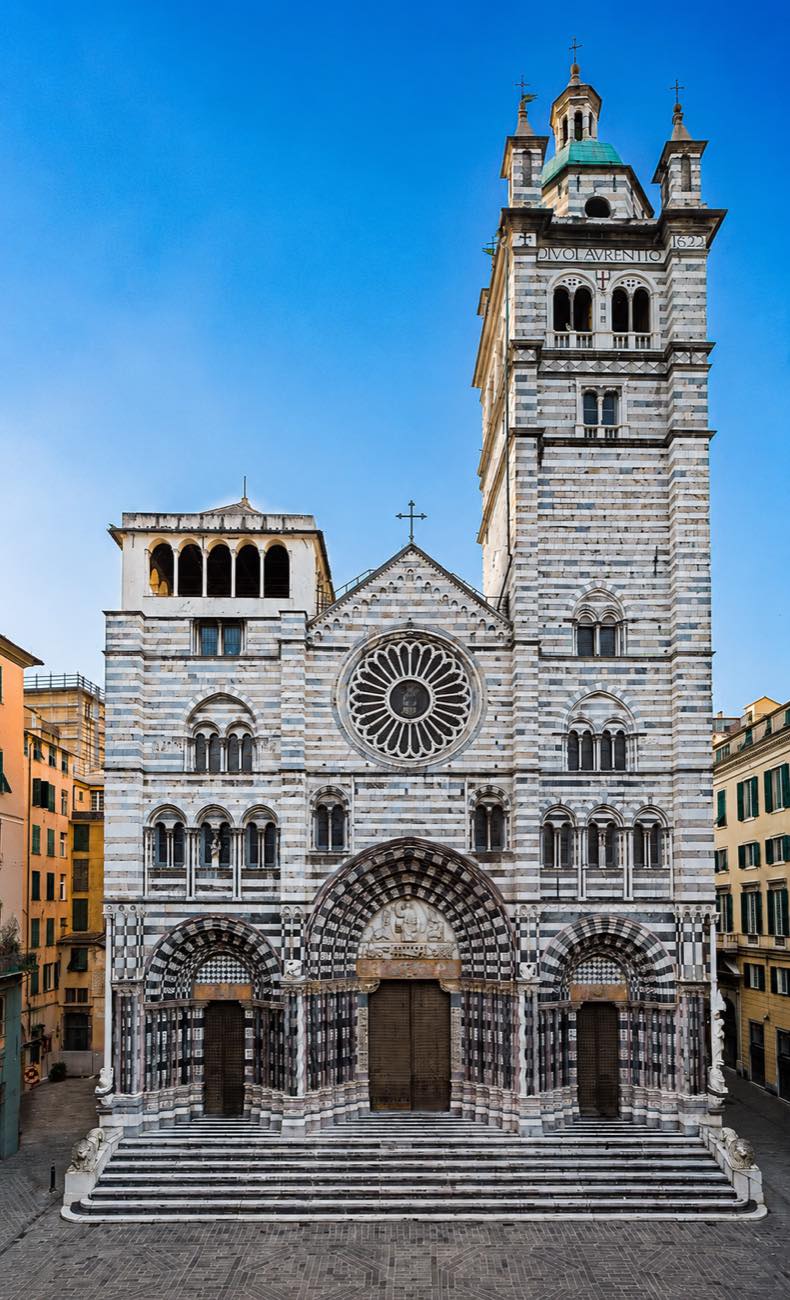
Genoa is the meeting point of the two great axes of European pilgrimage, between Santiago and Rome. Its Cathedral has guarded for more than nine centuries the ashes attributed to John the Baptist, which arrived in Genoa on 6 May 1099 on the return of the First Crusade. According to tradition they had been saved centuries earlier by a monk, after the desecration of the tomb, and kept at Myra until their transfer to Liguria: the Genoese were its custodians, so that the cult of the Forerunner could flourish again in the West. It is a historical and civic heritage, even before being a spiritual one, that makes the city a natural destination and new departure for pilgrimage.

— I. The Ways

Two Ways on foot, one extension, one single destination.

The two main Ways — the Western Way, from Madonna del Laghet, and the Eastern Way, from Lucca — converge on Genoa: nine stages each, 418 km in all. To these are added the extension of the Northern Way from Tortona and the Southern Crossing, by sea from Sardinia. Four gates, one single Beginning: the Cathedral of San Lorenzo and the ashes of the Precursor.

Western Way

Madonna del Laghet (FR) → Genova

The Western Way has a twofold soul: three uphill stages (41 km) cross medieval villages, oil mills, olive groves and sanctuaries of the Ligurian hinterland; the remaining stages can be walked along the Ciclovia Tirrenica Riviera dei Fiori, flat and accessible. The pilgrim chooses which version to walk. The two variants converge at Imperia (Oneglia).

Mountain variant · 41 km · 3 stagesSanremo → Taggia → Torrazza → Oneglia
204km
9stages
3.150m D+
See the 9 stages →

Eastern Way

Lucca (IT) → Genova

The Tuscan stretch from Lucca to Sarzana follows the Via Francigena; from Sarzana the main route passes by the Sanctuary of Soviore and crosses the coastal Ligurian Apennines. The three stages of the coastal variant (36.5 km) offer a seaside alternative for the La Spezia–Levanto stretch, with a visit to the villages of the Cinque Terre (UNESCO).

Coastal variant · 36.5 km · 3 stagesLa Spezia → Riomaggiore → Vernazza → Levanto
214km
9stages
5.150m D+
See the 9 stages →

Northern Extension

Tortona → Genova · Via Postumia

The natural extension towards the Po Valley. Three feeder branches — from Pavia, from Alessandria and from Piacenza — converge at Tortona, «the Sarria of the North»: the threshold beyond which the minimum 100 km for the Iohannea are accrued. From here the shared route follows the ancient Roman road, traced in 148 BC.

100km
5stages
1.950m D+
See the stages →

Southern Crossing

Porto Torres (Sardinia) → Genova · by sea

The last gate is the sea. From Porto Torres, in Sardinia, to Genoa in a single night of sailing, along the ancient routes of the relics and the pilgrims of the Mediterranean. It is the way of those who have already walked the Cammino di Santu Jacu: they land at dawn, climb to the Cathedral to visit the Baptist, before setting out towards Rome or towards Santiago. It does not count towards the 100 km of the Iohannea, but it grants the stamp on the credential and hospitality.

— Panoramas

A Way overlooking the sea.

The Way is, first of all, an experience of the landscape: along its stages the sea is almost always in view, among headlands, seaside villages, ancient Roman roads and paths suspended between olive groves and the horizon.

Tap a place to see its photo.

Headlands & promontories
01

Headlands & promontories

Tongues of land plunging into the sea, from the Riviera di Ponente to the Portofino headland.
Capo Sant'AmpelioCapo BertaCapo Santa CroceCapo NoliPunta MescoPunta BergeggiPromontorio di Portofino
Seaside villages
02

Seaside villages

Among the most beautiful seaside villages in Italy.
CervoVarigottiBergeggiFinalborgoLaiguegliaBoccadasseCamogliSestri LevanteCinque Terre · UNESCO
Terraces & passes
03

Terraces & passes

Verezzi four hundred metres above the sea; San Rocco sheer over the water.
VerezziSan Rocco di CamogliPasso del TelegrafoSentiero dei SantuariSalto della LepreGrotta dei Falsari
Historic roads
04

Historic roads

The Roman Via Iulia Augusta, facing the island of Gallinara.
Via Iulia AugustaSentiero del PellegrinoSito archeologico di Luni
Islands & archipelagos
05

Islands & archipelagos

Just off the coast, a stone's throw from the path.
GallinaraIsola di BergeggiPalmariaTino e Tinetto
Seafront walks
06

Seafront walks

~45 km of continuous coastal cycleway from Ospedaletti to Andora — Italian Green Road Award 2025.
Varazze–Cogoleto–ArenzanoBonassola–FramuraPasseggiata Anita Garibaldi · NerviOspedaletti–Andora
Inland villages
07

Inland villages

Bussana Vecchia: destroyed by the 1887 earthquake, today reborn as an artists' colony.
CastellaroLinguegliettaCivezzaBussana Vecchia

Photo creditsPlace photos via Wikimedia Commons (CC licence):
San Rocco di Camogli — Davide Papalini (CC BY-SA 3.0) · Bonassola — Terensky (CC BY 3.0) · Santuario di Montenero — Terensky (CC BY 3.0).
creativecommons.org · Wikimedia Commons. Other photos: Adobe Stock and the Quelli della Via APS archive. Grotta dei Falsari © Adelmo Bucci.

— II. Formats

Five ways, one single Way.

Five ways of living the Way, from a sabbatical month to a single weekend, on foot or by bike: choose the rhythm that resembles you.

1.

La Grande Via

18 giorni consecutivi per i due Cammini; 22 con le varianti.

2.

Weekend Pellegrino

9 weekend in una stagione, due tappe per volta. Fino a 11 con le varianti.

3.

Il Cammino dell'Anno

Una tappa al mese, in tutte le stagioni, per due anni di cammino lento.

4.

La Via in Bici

6 giorni per la Grande Via, 3 tappe a Cammino.

5.

La E-Bike

6 giorni da Mentone a Genova, solo Ponente, sulla Ciclovia Tirrenica.

— The freedom of the train

Set out when you want. Pick up again when you can.

It is a freedom other walking routes do not have, making the Way walkable all year round, in 18 days or in 9 weekends. Train plus walking means low-impact mobility: every stage a station, every step a new departure.

— III. The Stages

Stages on a human scale, averaging under 25 km.

Averaging under twenty-five kilometres, with every climb manageable, and every arrival before a resting place chosen for its history and its silence. The hospitality network is being built, open to every sensibility.

Distances, elevation and times are indicative and may change with the terrain, the weather and the signage. The Way is walked at your own responsibility: assess your fitness, get informed before setting off and always check that the accommodations are open. The association is not liable for accidents or damage occurring along the route.

— IV. Map

The Way, across the land.

We are mapping the Way from scratch, step by step. The grey lines are earlier tracks: we use them as a reference, but they are not the final route. We are drawing the official route by walking it: every section walked and recorded on survey turns to colour on the map and becomes official. The more colour you see, the closer the opening of the Way: support the mapping and help us complete it. Click the stages for kilometres, elevation gain and lodging.

—km mapped out of 418
Mapping in progress

Show
View
Cammino di Ponente Cammino di Levante Cammino di Settentrione Variante Already walked To be walked Sosta intermedia Genova · Meta

The tracks on the map, including the downloadable GPX files, are provided for information only and are still being verified: they do not replace official maps, signage on the ground and common sense. Anyone using them does so at their own risk.

— V. Who it's for

Perhaps it's you.

Four profiles you might recognise yourself in. Walk even if you are not religious. Walk even if you are already home.

You are searching for meaning

You are in your twenties or thirties and you wonder what you are doing with your life. You need silence, but you don't know where to find it. The Way gives you a direction and no answers. You walk, you listen, you decide.

Suggested format: Grand Way · 18 days

You feel burnt out

You work too much, sleep too little, you are always connected, you have one free weekend a month. The Way becomes 9 weekends in one season: you take the train on Friday evening, you walk two stages, and you return to the office on Monday a different person.

You are changing your life

You are leaving a job. You are ending a relationship. You are moving. You need time for yourself, slow, out in nature. The Grand Way accompanies you along the coast, from Menton and from Lucca to Genoa. By the time you arrive, you are already elsewhere.

You are seeking something greater

Perhaps you don't yet know what. A peace, a direction, a space different from that of everyday life. The Way is a threshold journey: you enter one way and you leave changed. The 18 stages are 18 moments to feel. You decide which voice to listen to: you can reconnect with nature, with the most spiritual part of yourself, or simply let yourself be guided by the silence, without having to give it a name or a label.

— VI. Credenziale

One seal. One credential. One Iohannea.

Cattedrale di San Lorenzo, Genova

The Credentiale Baptistae

The official credential of the Via di Giovanni Battista is the Credentiale Baptistae, issued by the association Quelli della Via APS: an iconographic document dedicated to the Way of the Baptist, with its own stamp for every stage and the keeping of a memory of the journey. It can be requested online and collected along the route, at the points of departure and at the main hubs (Menton, Lucca, Laghet, Imperia, La Spezia).

Alongside it, the Way recognises the Charta Peregrini of the Confraternita di San Jacopo di Compostella, the Credential of the Camino de Santiago and the Credential of the Via Francigena, provided they are completed with the stamps gathered along the stretch of the Via di Giovanni Battista. The Credentiale Baptistae qualifies the route as the Cammino del Principio, according to the Way's own identity; the other credentials certify it within the framework of universal pilgrimage.

The Iohannea

The Iohannea is the Testimonium of the Via di Giovanni Battista: the certificate attesting the completion of the Way, like the Compostela for the Camino de Santiago. It does not measure a distance covered, but a spiritual journey accomplished. It is received by those who have completed an entire Way — Western (204 km) or Eastern (214 km) — or at least 100 km on foot in the final stretch: from Imperia on the Western Way, from La Spezia on the Eastern Way, from Tortona on the Northern Way.

A document in Latin with Johannine iconography, it is signed by Quelli della Via APS, keeper of the Way; the signature of the Metropolitan Chapter of the Cathedral of San Lorenzo, keeper of the relics of the Baptist, is in the process of being formalized. It is not a souvenir. It is a baptism into the Way.

Where it is received: at the ticket office of the Cathedral of San Lorenzo in Genoa (Monday to Saturday, 9–12 / 15–18), and at the nearby Diocesan Museum, Via Tommaso Reggio 20r (Sunday, 14–18). At both you receive the final stamp on the credential and the Iohannea, before visiting the treasures of the Cathedral: the ashes of the Baptist in the Chapel of San Giovanni, the Sacro Catino and the reliquary arm with the Staff of Santiago.

— VII. A solemn appointment
24 June

The Feast of the Baptist.

On 24 June Genoa solemnly celebrates Saint John the Baptist, its principal patron since 1327. The ancient Casacce, coordinated by the Priory of the Confraternities for the Archdiocese of Genoa, lead the traditional Procession of the Ark towards the sea, commemorating the arrival of the relics in the city from the Holy Land, on 6 May 1099. Those who reach Genoa on that day live a moment of grace similar to the arrival at Santiago on 25 July. On that day the Iohannea is solemnly presented to the pilgrims, in the Chapel of San Giovanni Battista in the Cathedral, at the close of the Procession.

—days
—hours
—min
—sec
Countdown to 24 June 2026
— VIII. Which Way is right for you

Three questions, one direction.

No psychological tests, just a few seconds to work out where to begin.

Where are you starting from?

How much time do you have?

What are you looking for?

Your Way: —

Discover this Way → See the profiles
— IX. Direct questions

Have doubts? That's normal.

The questions we are asked most often. Honest answers.

Do I have to be religious to walk the Way?

No. The Way is open to all: believers, agnostics, atheists, those who are searching, those who are in doubt. The Way is a threshold: you enter as you are, you leave changed. You build its meaning yourself by walking. The churches, sanctuaries and sacred places along the Way are points of rest and of listening, not necessarily of membership. Faith is a personal choice; the Way belongs to everyone.

Can I do it alone?

Yes. Most pilgrims walk alone, at least for part of the route. The network of hospitality points means you never have to sleep in isolated places, and the encounters along the road come naturally. We only advise against the mountain stretches in the evening for those without hiking experience.

How much does it really cost?

The Way is affordable: you sleep in donation-based or partner hospitality (generally € 10–25 a night), you eat in Ligurian trattorias or cook when a kitchen is available (€ 15–25 a meal), the train between stages costs a few euros. The credential costs € 5, the Iohannea is free.

I'm not fit. Can I make it?

The average stage is under 25 km on manageable terrain (the Ciclovia Tirrenica (Tyrrhenian cycle route) is flat, running along the coast). If you walk for an hour a day for two months before setting off, you are ready. For those who are really out of shape: there is the Weekend Pilgrim format (2 stages at a time) and the Way by E-Bike from Menton to Genoa in 6 days.

Can it be done by bicycle?

Yes. The Western Way follows for much of its length the Ciclovia Tirrenica – Riviera dei Fiori, flat and separated from traffic. Classic version: 6 days by bike. E-bike version: 6 days, even for those who are not experienced cyclists.

Can I stop and start again another time?

Yes, it is one of the most useful features of the Way. The Ligurian coastal railway reaches every stage: you can stop, take the train, go home, and start again exactly where you left off. This is how the Year-Long Way works: one stage a month for two years, variants included.

What do I put in my backpack?

The essentials, nothing more. Comfortable, broken-in hiking boots, breathable socks, two changes of technical t-shirts, two pairs of light trousers, a rain cape, a water bottle, a sleeping-bag liner for hostels, a first-aid kit, shea butter, a phone with charger, your credential, an ID document. Backpack between 5 and 10 kg (recommended max 1/10 of your body weight). Whatever you forget, you'll find along the road.

When is the best time?

For Liguria: March–June and September–November are ideal. July and August are hot on the coast, but doable if you walk early in the morning. December–February works for the coastal side, avoiding the mountain stretches. 24 June remains the symbolic date: the Feast of John the Baptist in Genoa.

What is the difference between the three Ways?

The Western Way (Laghet→Genoa) is more "luminous and Mediterranean": Riviera dei Fiori, olive groves, palms, a flat cycle route, the sea always to your left. The Eastern Way (Lucca→Genoa) is more "vertical and contemplative": Versilia, the Apuane mountains, Cinque Terre, resting places up in the heights. The Northern Way (Tortona→Genoa) is the inland side: the Tortona hills, the vineyards of the Gavi, the Bocchetta Apennines, along the ancient Via Postumia. Many walk more than one of them in the same year, alternating them by season.

Can I set off from northern Italy?

Yes. The Northern Way is designed precisely for those coming from Lombardy, Piedmont and Emilia: three branches — from Pavia, Alessandria and Piacenza — converge on Tortona, from which a common trunk of about 100 km descends to Genoa along the Via Postumia.

What is the Iohannea?

It is an act of baptism that turns the wayfarer into a pilgrim and, at the same time, an act of threshold: the sign that you have crossed through something, ready to set off towards new destinations. You receive it in Genoa, at the ticket office of the Cathedral of San Lorenzo (Mon–Sat 9–12 / 15–18; Sunday 14–18 at the Diocesan Museum), by presenting the stamps gathered on your credential, before venerating the relics of the Baptist. You earn it by completing an entire Way — Western or Eastern — or by walking at least 100 km on foot in the final stretch. It is signed by Quelli della Via APS; the signature of the Metropolitan Chapter of the Cathedral of San Lorenzo is in the process of being formalized. A document in Latin, ancient iconography, ivory paper.

— X. Support the Way

A free donation for the Way.

Quelli della Via APS lives on the support of those who walk. With a free donation you help care for trails, waymarks and hospitality along the Way of the Beginning.

— XI. Pilgrim Area

Your Way.

Create your pilgrim profile: track the stages you have completed, collect digital stamps, keep your credential online. One profile, one Way, the same for everyone.

Access your digital credential

Not registered yet? Create your pilgrim profile in just a few seconds.

— XII. Association

Become a member.

Quelli della Via APS is made by the people who support it. By joining you become part of the association, take part in the members’ assembly and walk with us all year round.

Member under 30
€ 20/year

Reduced fee for those under 30. Same rights as an ordinary member.

Ordinary member
€ 25/year

The basic membership fee. Right to vote in the assembly and to take part in the life of the association.

Give more
Supporting member
€ 50/year

Same rights as an ordinary member, with a more generous contribution to the Way and its network of hospitality.

Ambassador member
€ 100/year

For those who represent and promote the Way in their area. Same rights as an ordinary member.

To join you need a pilgrim profile (free) with a verified email. The fee can be paid straight away with PayPal or card, or by bank transfer: in that case the instructions arrive by email right after your application.